Tribal Arrow: A Grounded, Versatile Embroidery Design
First Impressions: Bold Simplicity with Cultural Warmth
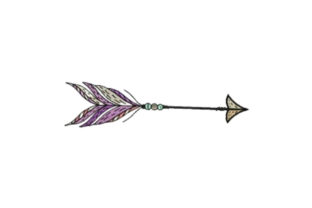
When I opened the Tribal Arrow embroidery file, what struck me first wasn’t complexity—it was clarity. This isn’t a fussy, over-layered motif. It’s a single, confident arrowhead shape rendered in clean lines and intentional negative space—evoking tradition without leaning into cliché. The design carries quiet strength: earthy, grounded, and just detailed enough to hold visual interest at 3–4 inches wide. As a designer who regularly selects motifs for client projects, I immediately pictured it on a heavyweight cotton tote bag for a local outdoor gear shop—stitched in deep forest green thread on natural canvas. That pairing feels authentic, not forced.
Where Tribal Arrow Truly Shines (and Why)
Tribal Arrow works exceptionally well for custom apparel where subtlety and symbolism matter more than flash. On a midweight sweatshirt? Yes—especially when placed off-center on the chest or along the sleeve seam. On a baby onesie? Thoughtfully scaled down (test that first), it reads as gentle and meaningful—not aggressive. For an embroidered patch? Its compact silhouette and balanced weight distribution make it ideal for iron-on or sewn-on applications on backpacks, denim jackets, or camp-themed aprons.
I recently used a version of this design for a small-batch run of linen tea towels sold at a regional craft fair. Customers responded strongly—not because it screamed “look at me,” but because it felt intentional, hand-chosen, and quietly aligned with their values: simplicity, nature, craftsmanship. That’s the quiet power of Tribal Arrow. It supports your brand voice instead of competing with it.
Real-World Fit: From Campfire Gear to Nursery Walls
- Tote bag design: Holds up beautifully on textured canvas—no lost detail in the fill stitch areas, even with moderate stitch density.
- Sweatshirt embroidery: Works best on flat, stable panels (back yoke or lower front); avoid curved seams unless you’ve tested stabilizer layers thoroughly.
- Baby embroidery: Softens nicely on organic cotton—just confirm thread colors are Oeko-Tex certified if selling commercially.
- Holiday embroidery: Surprisingly effective on rustic ornaments or linen pillow covers for fall/winter gifting—pair with neutral thread and minimal embellishment.
- Commercial embroidery: Clean vector-like edges translate well across multiple hoop sizes, making it scalable for boutique branding or wholesale apparel lines.
Where to Proceed with Care
Tribal Arrow is forgiving—but not magic. On thin or stretchy fabric like lightweight jersey or rayon challis, the arrow’s outer edges can blur without proper cutaway stabilizer. I learned that the hard way on a test run for a women’s cap sleeve top: the satin stitch outline softened too much, losing definition. Similarly, dark fabric demands careful thread color contrast testing—what reads as rich charcoal on white may vanish entirely on navy unless you add a subtle underlay or switch to a matte metallic.
Avoid cramming Tribal Arrow into tiny hoops (under 3" diameter) without checking how the inner angles render. Some versions compress the tip too tightly, causing skipped stitches or thread breaks. And while it’s not an applique design, don’t assume it’s low-density—review the stitch count in your embroidery software. Dense fill areas can stiffen lightweight fabrics, affecting drape on items like scarves or baby swaddles.
What It Adds to Your Finished Product
Tribal Arrow elevates perceived value without raising production cost. Because it’s visually cohesive and thematically resonant, customers intuitively read it as “designed”—not downloaded. That builds trust, especially for Etsy sellers or handmade shops where buyers pay a premium for authenticity. When stitched cleanly on a high-quality kitchen towel or personalized gift, it signals care, consistency, and attention to detail—key drivers of repeat purchases and word-of-mouth referrals.
It also plays well in digital spaces. As a digital embroidery file, Tribal Arrow previews clearly in printable mockups—no pixelation, no awkward scaling. That’s vital for craft business owners building listings or social media assets. And unlike overly intricate designs, it doesn’t require heavy editing to fit different product templates, saving real time in your workflow.
Practical Designer Notes Before You Stitch
- Always test Tribal Arrow on scrap fabric matching your final project’s weight and weave—especially for custom apparel or baby embroidery.
- Check thread color contrast on both light and dark backgrounds before committing to a full run.
- Review stitch density in your embroidery software—adjust underlay if stitching on textured or unstable fabric.
- Confirm hoop size compatibility; some versions include multiple sizes—choose based on your garment placement, not just default settings.
- Inspect corners and sharp points at actual stitch-out size—tiny details can vanish or distort if not digitized thoughtfully.
- Use appropriate stabilizer: cutaway for knits, tear-away for stable wovens, and fusible + tear-away for layered items like patches.
- If selling finished products or digital embroidery files, verify licensing terms—some Tribal Arrow variants allow commercial use, others do not.
Final Thought: A Design That Serves the Project, Not the Other Way Around
Tribal Arrow doesn’t demand attention—it earns it. As a machine embroidery design, it respects the craftsperson’s time, the customer’s taste, and the integrity of the handmade product. Whether you’re stitching for a camping-themed boutique, personalizing a holiday gift, or building a cohesive line of small shop products, it integrates smoothly—never overwhelming, never underwhelming. It’s the kind of embroidery file that reminds you why you started designing in the first place: to make things that feel both meaningful and made-to-last.